Statistical Sciences
Department of Statistical Sciences, Faculty of Arts & Science
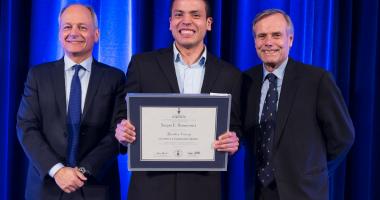
Sergio Betancourt is not only an assistant vice president, he's also a Statistical Sciences grad.
Sergio Betancourt (B.Sc., 2015) is the Assistant Vice President of Equities Electronic Execution at Citigroup who credits his experience in case competitions, collaborative research and projects as having developed his leadership, communication and research excellence. Read more about Sergio on LinkedIn.
What skills can Statistical Sciences graduates use in their careers?
Within two years of entering the labour market, 84% with undergraduate degrees in this area of study are employed with a median salary of $90,000/year.
69% of those graduates go on to pursue further education. (Sources: Statistics Canada Employment Income and Further Education Data from Class of 2020.)
Industry Pathways
Alumni with a degree in Statistical Sciences have often pursued these industries:
- Data Science & Analytics
- Banking & Financial Services
- Investment & Asset Management
- Insurance & Risk Management
- Software Development & Engineering
- Research & Development (STEM)
- Consulting (Management, Strategy, HR)
- Artificial Intelligence & Machine Learning
Further Education Pathways
Alumni with a degree in Statistical Sciences have often pursued these further education options:
- Master of Science (MSc)
- Doctor of Philosophy (PhD)
- Master of Data Science / Analytics
- Master of Business Administration (MBA)
- Master of Finance (MFin)
- Master of Information / Information Systems
- Master of Engineering (MEng)
- Graduate Diploma
Exploring connections between your degree and career
Learn about yourself
Register for Job Shadowing to connect with professionals in your field of interest, like a Statistical Science alum and financial insurance specialist at Sunlife Insurance, through a half- or full-day placement that helps clarify your goals and explore career paths.
Attend an In the Field program to meet professionals working in various roles within one organization.
Find a Work Study Position to apply your academic skills in paid, on-campus roles that offer hands-on experience and insight into career possibilities.
Join a career workshop or small group conversation to explore options, understand your strengths, and plan for your future. Visit the Career and Co-Curricular Learning Network (CLNx) for more information.
Build Your Network
Find the University of Toronto on LinkedIn and connect with peers, professionals, and alumni who can support your career journey.
Access U of T's Hub on Ten Thousand Coffees —an online networking platform with over 12,000 students and alumni—to exchange career advice, attend webinars, and explore career paths through one-on-one conversations.
Join networking events, panels, and career fairs through CLNx to connect with employers and alumni for career advice, informational interviews, and referrals.
Volunteer opportunities are a great ways to expand your connections and gain industry insight.
Explore identity-focused mentorship opportunities—such as the Black Alumni Mentorship Program—to connect with mentors who share your lived experiences and can support your personal, academic, and professional growth. If you have questions about the program, connect with Modele Kuforiji at mod.kuforiji@utoronto.ca.
Student Life’s Mentorship & Peer Programs also provide engagement opportunities for African Black Caribbean, Latin American, Southeast Asian, and First-Generation students, helping to promote academic and career wellness while fostering belonging and community. If you have questions about this programming, contact Adonica Huggins at adonica.huggins@utoronto.ca.
Connect with your peers and recent graduates at events hosted by the Actuarial Science Club.
For Actuarial Science students, find an alumni mentor who is a professional actuary through the Actuarial Science Mentorship Program.
Explore Your Program
Explore your area of study by connecting with faculty and peers and finding opportunities that enrich your academic and professional journey.
Talk to professors to better understand your discipline and identify meaningful learning experiences.
Get involved in student groups and leadership roles to spark new ideas, expand your perspective, and open unexpected opportunities.
Take advantage of faculty advising and support services, and explore internships through professional associations to gain hands-on experience in your field.
Apply to the Arts and Science Internship Program (ASIP), where you will complete Professional Development programming plus a minimum of 12 and maximum of 20 months of paid, full-time, academically related work experience.
Take advantage of socials organized by your student union.
Actuarial students can take courses that are accepted as criteria for professional accreditation.
Attend workshops, educational and social events hosted by the U of T Statistics Club.